
The Conditional Creative
ADHLAL INSIGHT PAPER · THE SOCIAL LEGITIMACY OF CREATIVE WORK
The Conditional Creative
Respected work that isn’t yet trusted as a livelihood
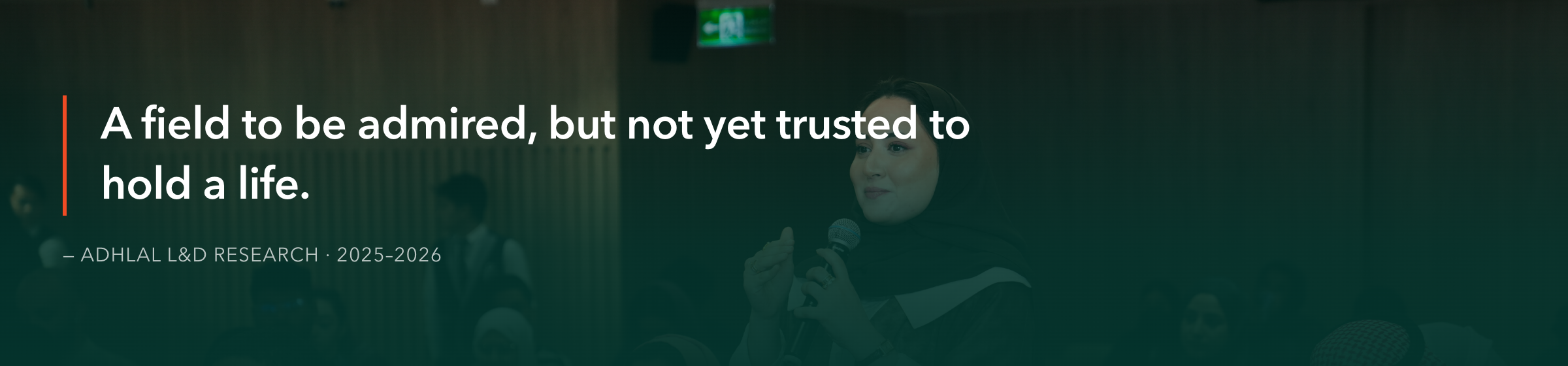
Increasingly respected. Encouraged at home. And still not quite trusted to hold a life.
An Adhlal insight paper, drawn from the Learning & Development research (2025–2026) across Saudi Arabia’s creative economy.
Riyadh · 2026 · 9 min read
THE READING
A creatively engaged cohort in Riyadh, 2025–2026.
When people in Saudi Arabia’s emerging creative economy describe how their work is seen, a consistent picture emerges. Creative work is increasingly respected. It is encouraged at home. And yet, for a large share of the people doing it, it is still not consistently read as a career.
This is not a tension the sector talks about openly, but it runs through Adhlal’s recent Learning & Development research, conducted in late 2025 and early 2026. Among the respondents in this research, creative work appears to have gained social respect, but it is not yet consistently perceived as a dependable career. That distance shapes who commits to creative work full-time, who keeps it to the side, and who is still deciding.
We call the person standing in that gap the conditional creative. The condition sits in the surroundings, not in the person. Their participation is real but provisional — not because they are hesitant or insufficiently committed, but because the pathway in front of them is not yet dependable.
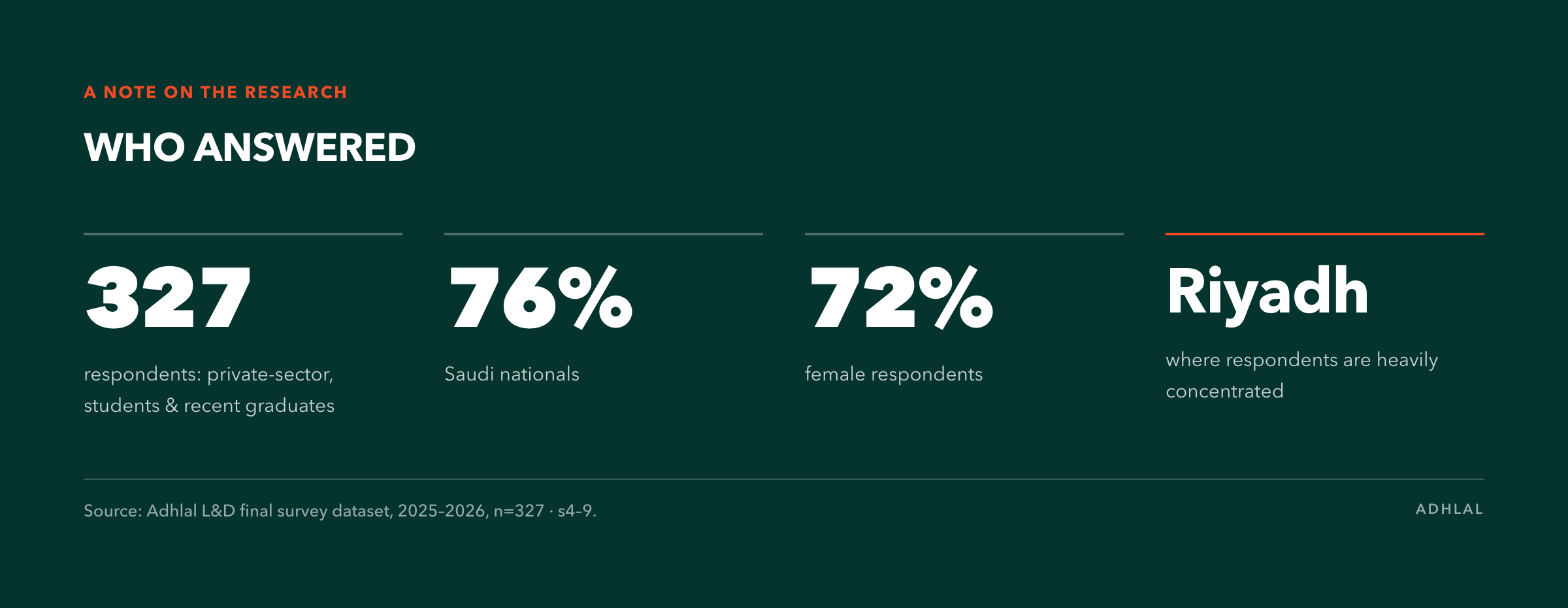
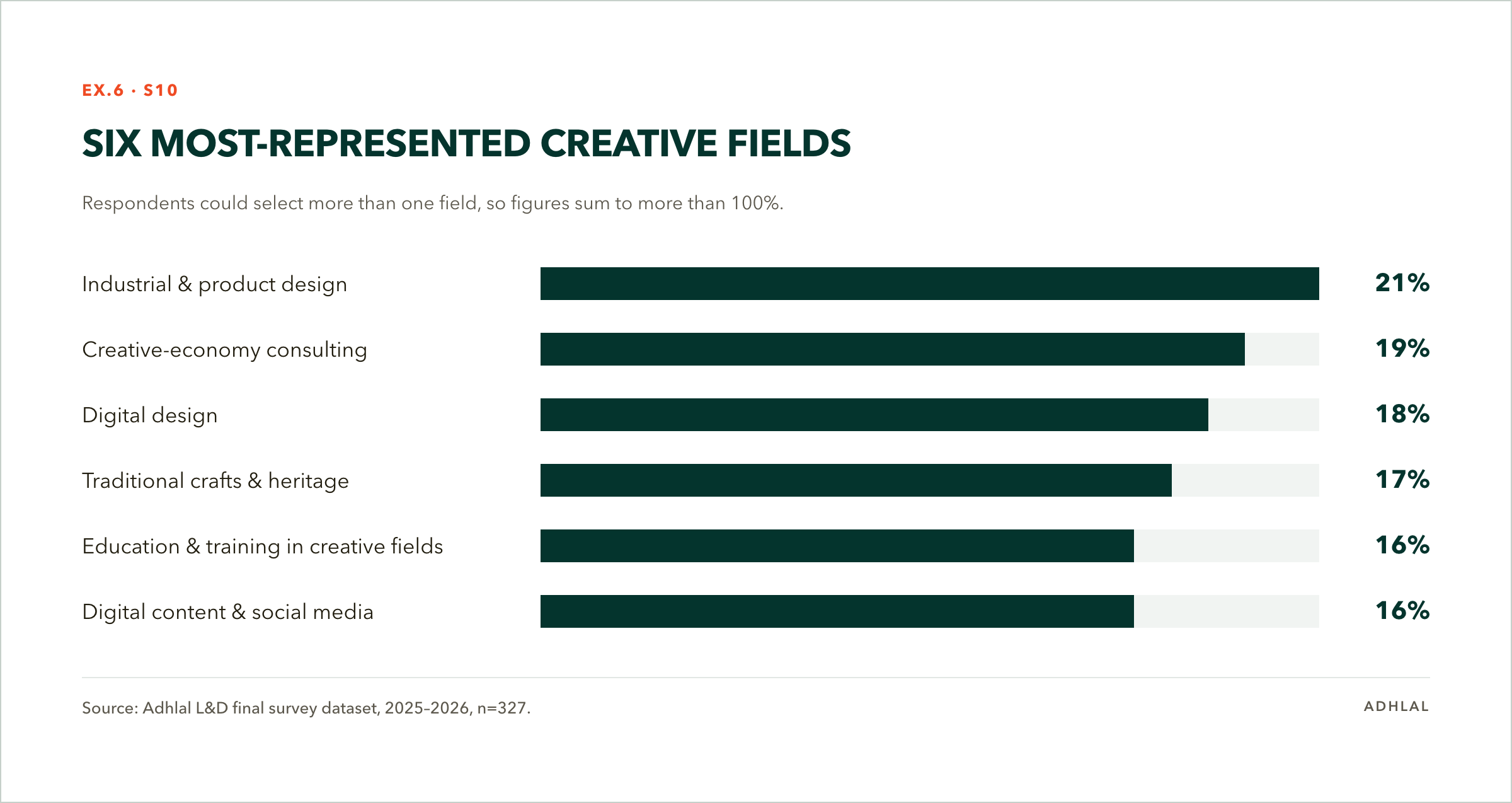
The sample spans a mid-career cohort alongside students and recent graduates, with private-sector professionals and students together making up roughly two-thirds of respondents (s4–9). It is also self-selected, highly engaged and creatively affiliated by design: a strength for depth of insight, and a limit we name openly. This is a meaningful reading of a specific group, not a claim about every young person or every creative worker in Saudi Arabia. The figures here are read directly from that dataset rather than modelled or extrapolated.
SECTION 01
Respected work
The first thing the data makes clear is that, within this cohort, the reputational foundation is already there.
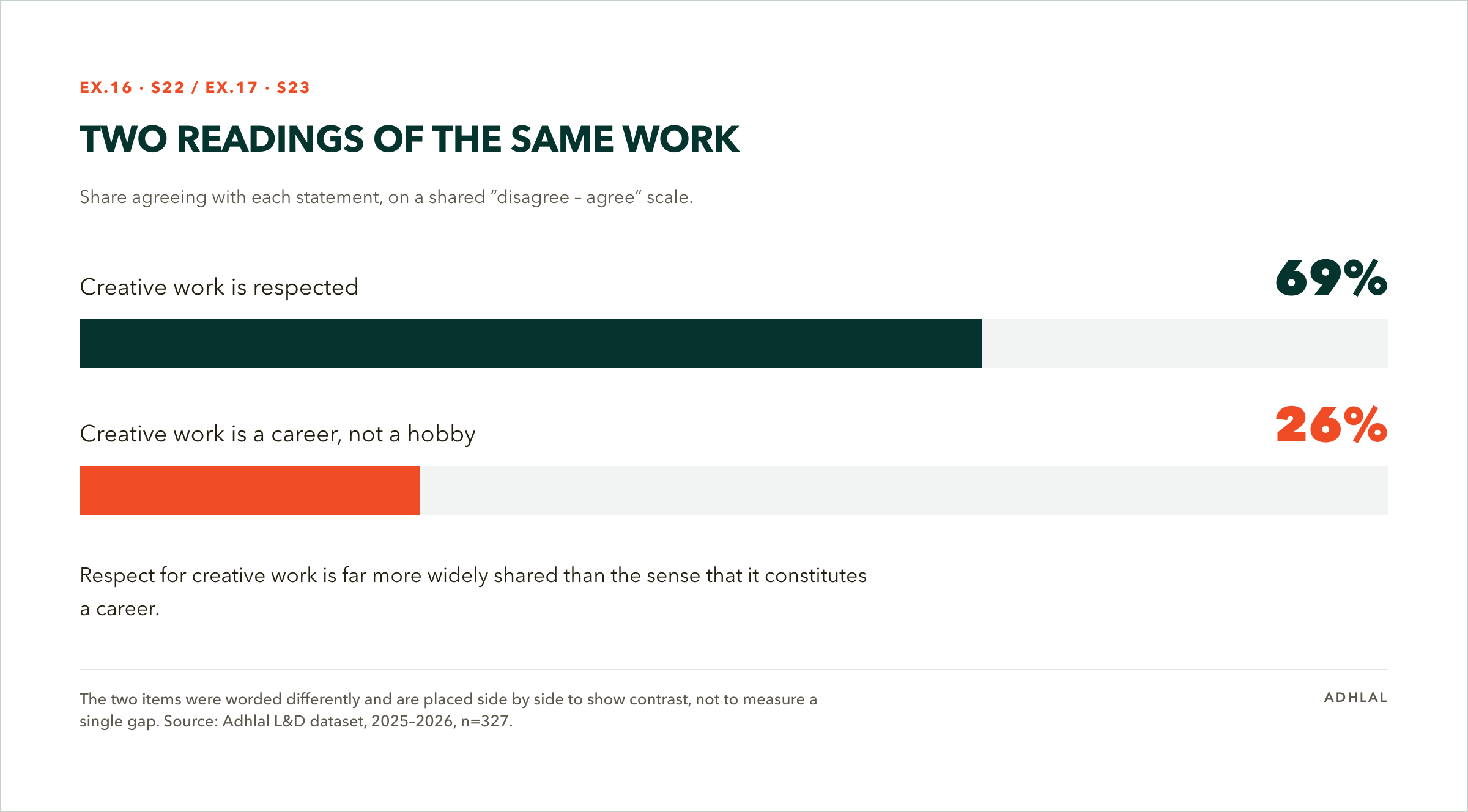
Asked how far they see creative work as a respectable career, respondents lean firmly positive: a mean of 3.86 on a five-point scale, with close to seven in ten agreeing, around one in five neutral, and just over one in ten disagreeing (Ex.16, s22).
Support from immediate environments points the same way. Perceived family encouragement to pursue a creative career sits higher still, at a mean of 3.92, with roughly seven in ten respondents describing their families as encouraging and discouragement rare.
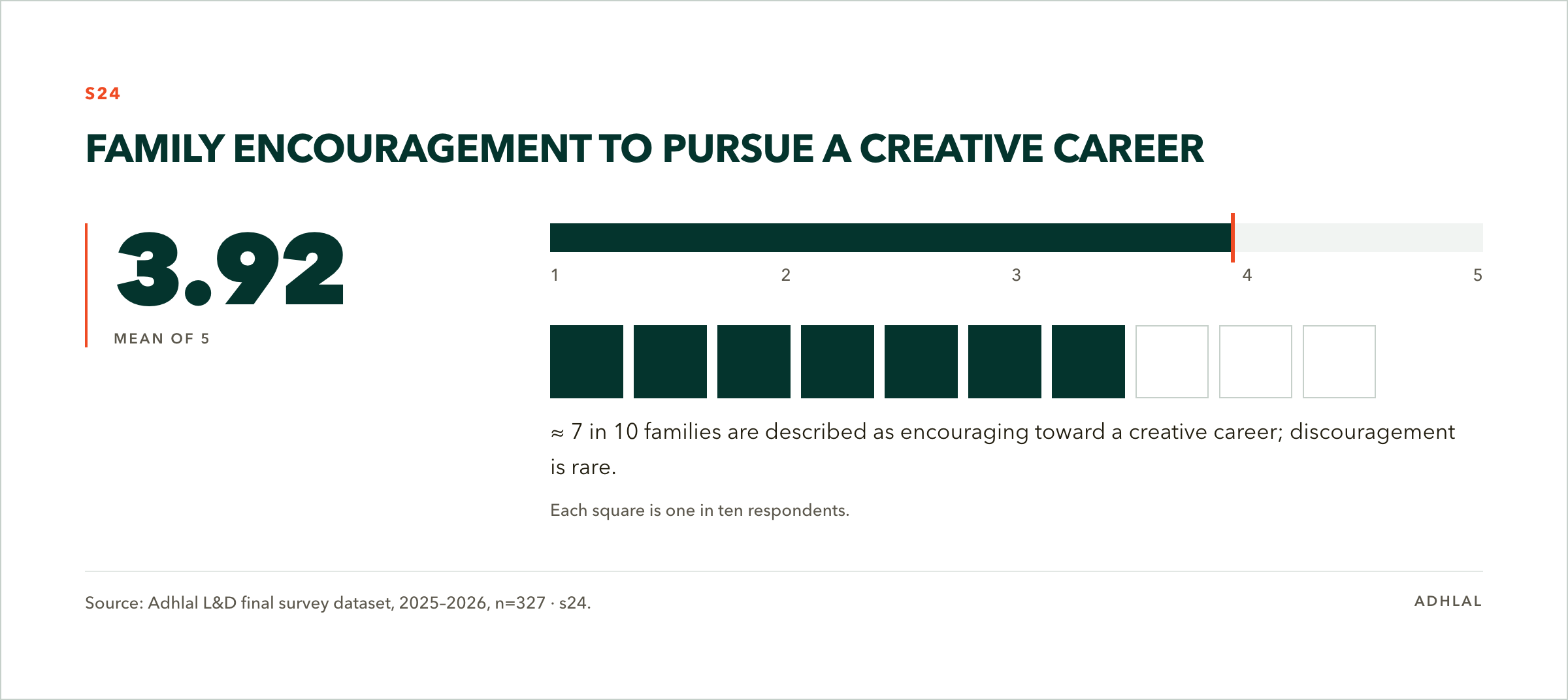
Read against Adhlal’s earlier Design Industry research of 2017–2019, both readings point upward — though the two studies used different samples and instruments, so the comparison indicates direction rather than a measured change.
Together, these findings challenge an assumption often treated as the sector’s central obstacle: that social disapproval and family resistance remain the main barriers. Within this sample, they are not. That does not establish that family resistance has disappeared across regions, generations, income groups or creative fields; the research cannot speak to that. But it does suggest that, for a creatively engaged cohort in Riyadh, a baseline of social legitimacy is already in place, and the sector’s difficulty lies elsewhere.
SECTION 02
But not yet trusted as a livelihood
The difficulty becomes visible the moment the question shifts from respect to livelihood. When respondents are asked whether creative work is viewed primarily as a career or primarily as a hobby, the consensus dissolves.
More respondents lean towards viewing creative work as a hobby than as a career, while a substantial group remains neutral. Just over a quarter place it clearly on the career side.
For the people in the research, this is not an abstract distinction. It is the difference between being encouraged to pursue something and being confident that it will sustain them.
A necessary caution: what the research captures is perception. It tells us how respondents read the standing of creative work. It does not yet tell us whether they can earn a reliable income, find regular work, or sustain themselves over time. The gap this paper describes is a gap in perceived dependability — which matters enormously for who enters and stays, but is not the same as a measurement of economic viability.
SECTION 03
The conditional yes
What makes this more than a diagnosis is how much movement sits latent inside it. Respondents were asked how likely they would be to pursue creative work full-time if it were perceived as stable and respected. A majority said they would consider it.
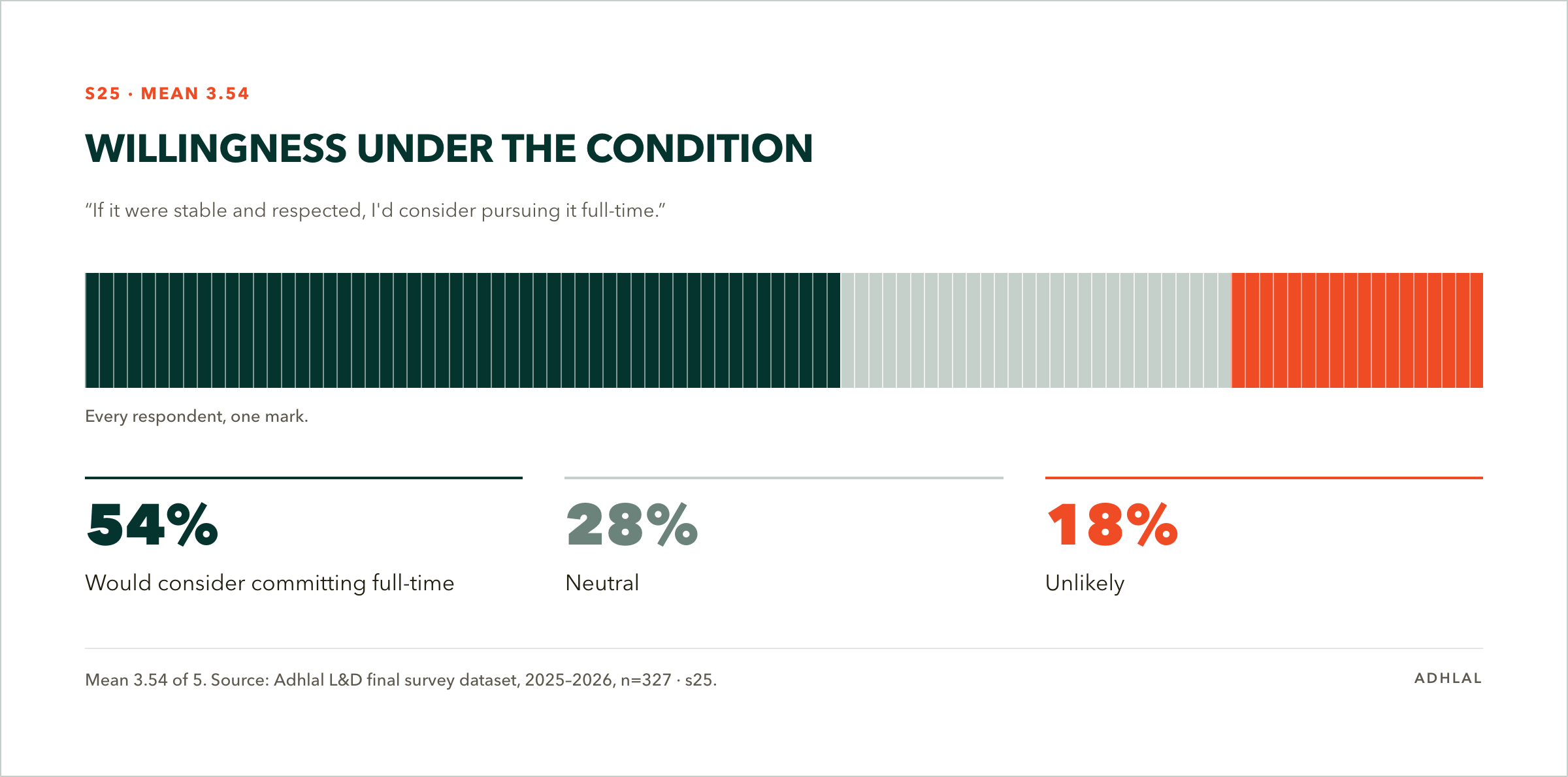
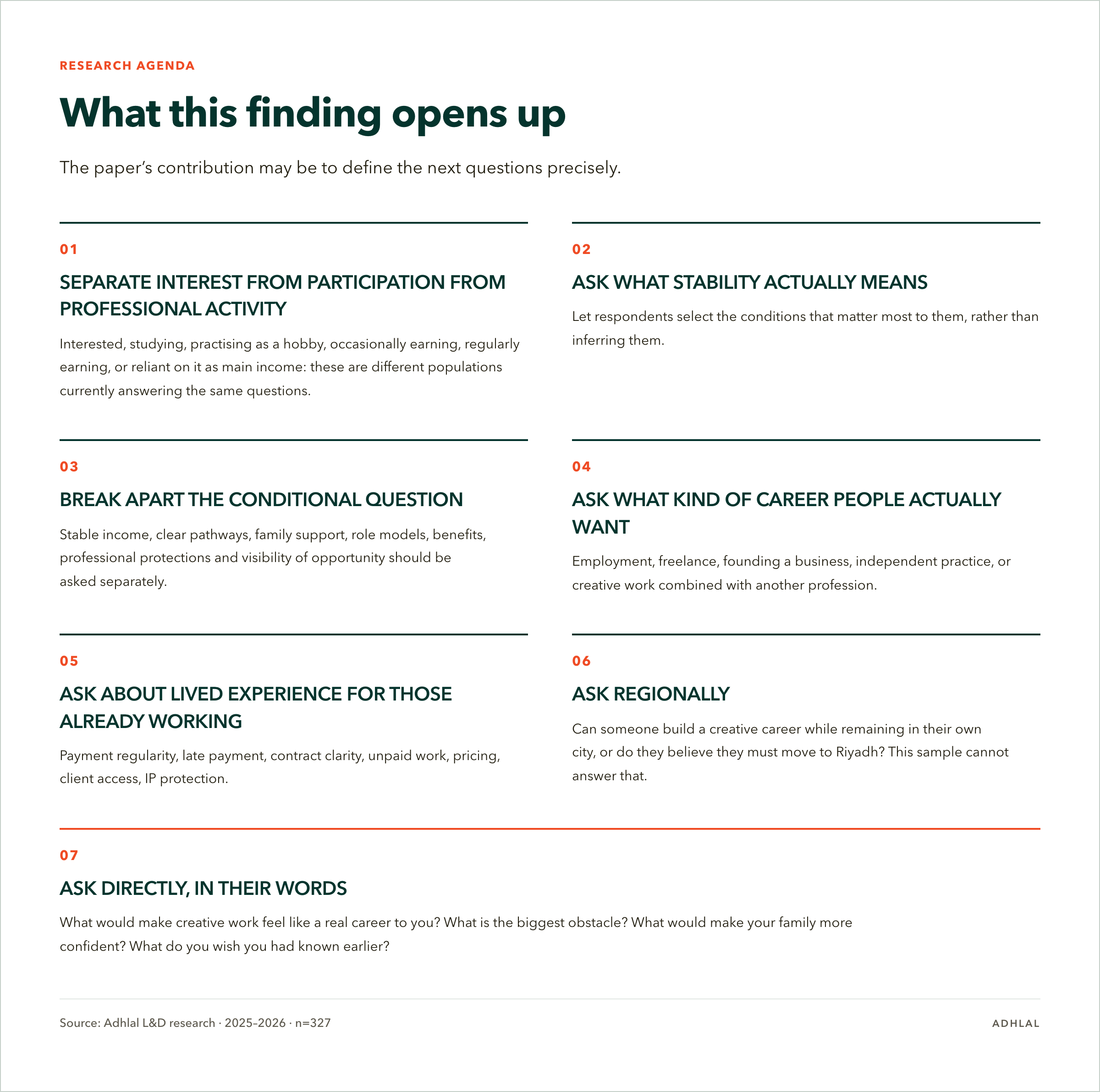
The response suggests that perceived stability and social legitimacy together influence willingness to commit full-time. Because the question combines both conditions, we cannot isolate which one carries more weight; separating them is one of the first tasks for the next round of research.
The pattern holds when the measures are set against one another. Respondents who see creative work as a career are more likely to be working in it full-time and to identify as part of the creative economy; those reporting stronger family encouragement and higher perceived respect are more likely to pursue it (s26). Perception and participation move together.
A note on what “full-time” means here. The question asks about full-time commitment, and the answers should be read within that frame. Many serious creative careers are freelance, entrepreneurial, project-based, or deliberately combined with other work. Someone who prefers a hybrid or independent model is not necessarily waiting to become full-time; they may have chosen a different mode of professional participation. Future research should distinguish between employment, independent practice, entrepreneurship, freelance and portfolio careers, and creative work pursued mainly as a personal practice, rather than treating full-time employment as the natural endpoint of a real career.
SECTION 04
The recurring neutral segment
There is a third group in the data that is easy to overlook, and it may be the most important for anyone thinking about how the sector grows. Across each of these measures, a consistent neutral segment appears: around one in five on whether creative work is respected, and close to three in ten on whether they would commit full-time even under favourable conditions.
This recurring neutrality may be one of the most important things to understand about the sector, and it is precisely where the current research stops. A neutral answer could reflect uncertainty. It could equally reflect mixed experience, limited visibility of pathways, satisfaction with part-time or hybrid participation, or a question that does not map onto how the respondent sees their own career.
We do not yet know which. Establishing that is a defined next question for Adhlal, and a segment worth designing research around rather than assuming into shape.
SECTION 05
From perception to conversion
Taken as a whole, the research describes a creative workforce that is willing before it is certain. Many respondents are already engaged in creative work, and a larger share express an intention to make it their main career: a latent willingness to participate that current pathways may not yet fully absorb (s4). The respect is present, the family support is present, and a majority would consider committing under the right conditions. What is missing is not appetite but assurance.
The pattern repeats across the groups the research examines. Among private-sector professionals, employed and self-employed alike, creative work is generally respected and supported, but less consistently viewed as a dependable career (s60).
There is a term doing a great deal of work in all of this, and it deserves to be named rather than assumed. Stability could mean regular income, permanent employment, predictable contracts, reliable payment, benefits, access to clients, career progression, intellectual property protection, the ability to remain in one’s own region, or simply confidence that opportunities will still exist in five years. The research identifies stability as a decisive condition. It does not yet tell us what stability means to different creative workers. That becomes one of the next questions for Adhlal.
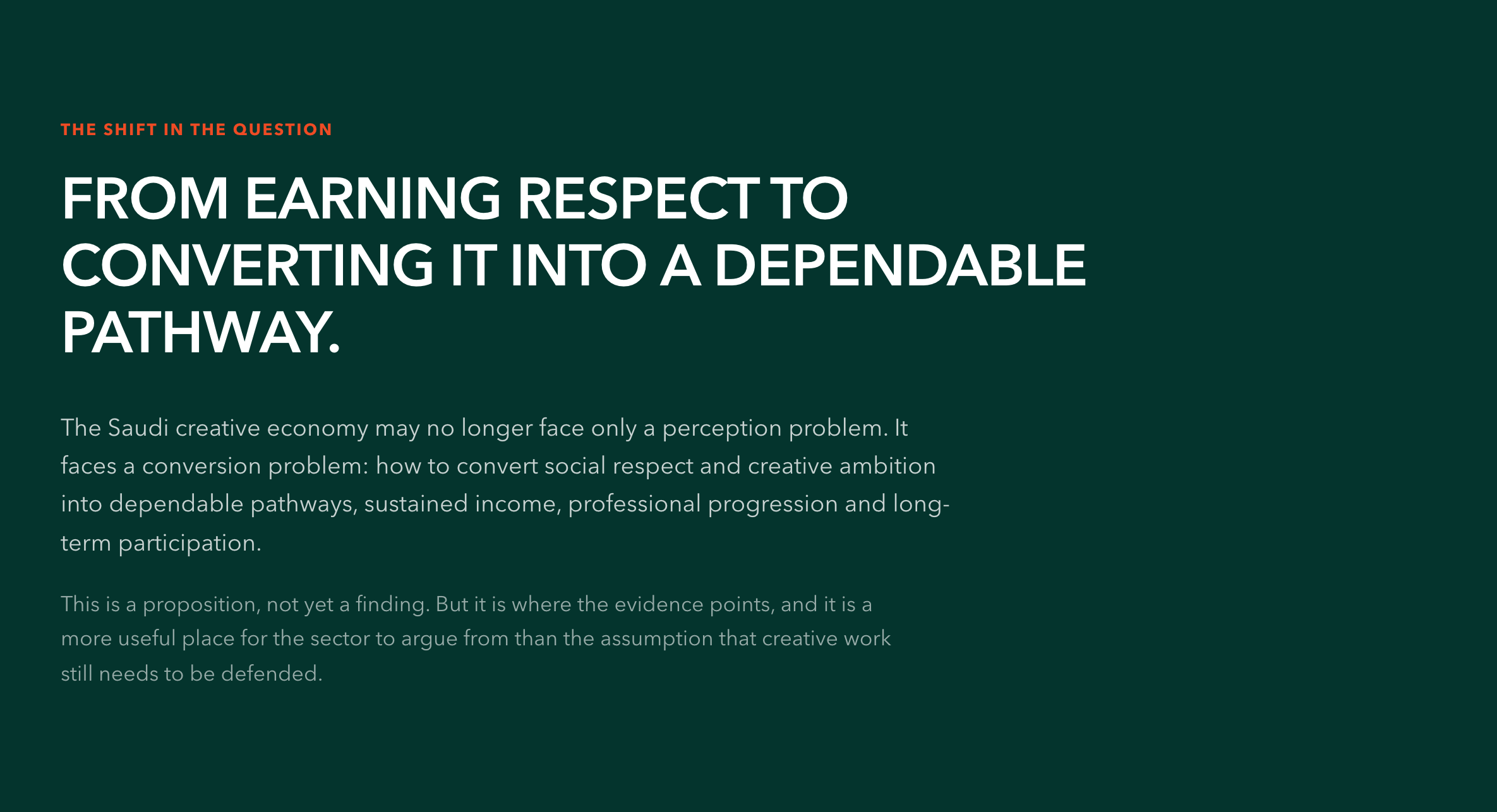
What the findings do suggest is a shift in the question the sector needs to answer:
Be part of Adhlal’s research
If this condition reflects your experience of creative work, or complicates it
We share these findings not as conclusions but as a reading of where the sector stands, and as an invitation. Adhlal is the Research Institute on the Future of the Saudi Creative Economy, and this research continues.
related posts
comments (0)
log in to join the conversation. log in
no comments yet.