
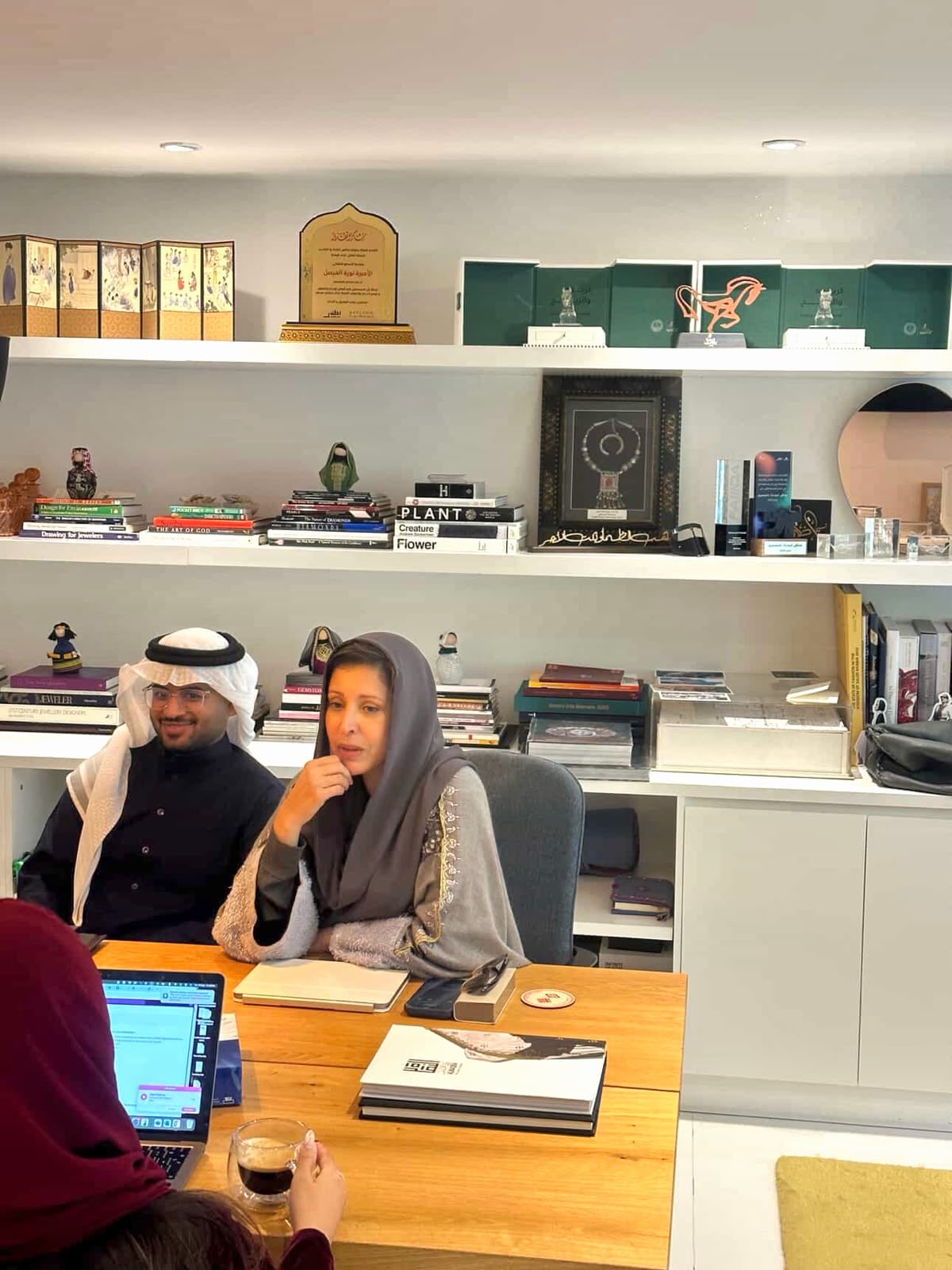
From Observation to Contribution: My Summer at Adhlal
My time at Adhlal did not start on my first day in the office. It started months earlier, when I had the privilege of shadowing my mentor, HRH Princess Nourah Alfaisal, in her roles as CEO of Art of Heritage, Founder & CEO of Adhlal, and Chairwoman of the Industrial Design Association NGO and the Saudi Youth Society NGO. Watching her move between teams and connect individual projects to a larger purpose taught me more than I could have learned in a classroom. Under her mentorship, I also began to understand the value of building genuine professional relationships and how much meaningful work depends on the connections and trust that surround it.
That experience shaped how I came to understand leadership. It goes beyond authority or title and lies in the ability to develop people, organisations, and ideas. When I returned to Adhlal for the summer, I wanted to take the next step in my learning: to move from learning through observation to learning through contribution, supporting the team wherever I could add value.
Starting Without a Fixed Plan
I started without a fixed checklist of tasks. My hope, more modestly, was to keep strengthening my critical, creative, and innovative thinking skills through whatever work came my way.
I was introduced to three workstreams: Adhlal's digital content experience, research for a youth initiative, and the emerging product around Futures Thinking. All three were still taking shape, so I often had to contribute before I could see the full picture. That uncertainty took some getting used to, but I found it was where I learned the most.
Rebuilding the Digital Content Experience
My first real project was supporting the communications lead on improving the Insights section of Adhlal's website. What began as a design refresh grew into a broader question the team was already grappling with: how do visitors discover and understand content, and how does a platform stay organised as it scales?
I contributed thinking on navigation, content categories, visual structure, and editorial quality, trying to look not only at how the site appeared, but how it might hold up as it grew. That work also fed into mapping out a publishing process, from initial idea through writing, review, translation, and approval. It reinforced something I had not fully appreciated before: one good article does not build a platform, but a clear, repeatable process helps one take shape.
Along the way, a broader question came up that I was glad to think through with the team: how might Adhlal use AI without losing its voice? AI can support research and efficiency, but it can also dilute authenticity, which matters a great deal for a platform built on personal insight. I tried to help frame authenticity as a strategic consideration, not just a stylistic one, since it ultimately came down to a question of trust and editorial identity.
Learning to Focus
Partway through the summer, after discussing it with my team, I stepped back from the youth-initiative research to spend more time on the website and the digital product development. The project was meaningful, but I felt I could contribute more elsewhere.
It was a useful lesson that saying yes to everything can look like productivity; however, it does not necessarily always add up to impact. Learning to ask where I could genuinely help and being honest with myself about it was one of the quieter lessons of the summer.
The Adhlal Digital Product
This was the part of the summer I am most grateful for. It gave me the chance to work again with Jeroen Frumau, whom I had first collaborated with on an AI-powered career coach concept during the academic year. His way of turning uncertain ideas into sharper opportunities and his habit of asking me to explain the reasoning behind every choice taught me how to approach this project and future ones.
Starting with real people. Since a digital product depends on people choosing to participate, I contributed to early user personas and journey maps, trying to ground them in realistic motivations, concerns, and barriers, such as unclear benefits or limited trust. It was a helpful reminder that design works best when it reflects how people actually behave, rather than assuming how they might.
Sitting with the "why." One question kept coming up: not just what users might do, but why they would participate. Recognition, learning, visibility, and belonging only matter if people genuinely value them. Working through that question helped me move from thinking about activities to thinking about motivation.
Using benchmarking carefully. I looked at international platforms built around trends, signals, and innovation, but tried to be careful that this stayed a learning exercise rather than a copying one. I looked at how those platforms attracted contributors, structured information, and rewarded participation, then asked which of those lessons might reasonably apply here.
Considering the local context. Trust, recognition, and community do not necessarily mean the same thing everywhere. Public recognition might appeal to one user and feel uncomfortable to another, and who is offering it can matter as much as the recognition itself. I tried to weigh each international example against this before assuming it would translate.
I was not immediately convinced by the Adhlal Digital Product as a concept. At first, I found the logic of the personas and journeys more persuasive than the idea itself. Research, benchmarking, and honest discussion with the team gradually helped close that gap. If there is a lesson I will take with me from this, it is that confidence built through close examination tends to be more durable than confidence that comes easily.
Saying Yes to the Unexpected
When Roy Baladi, the CEO and Founder of Kanz, visited the office and mentioned that he was organizing the Kanz AI Training Hackathon, a Guinness World Record attempt organized in partnership with the Ministry of Human Resources, HRH Princess Nourah Alfaisal encouraged me to take part, and I did. It was not part of any plan, just an opportunity I did not want to pass on. It was a good reminder that growth does not always come from a project brief; sometimes it comes from a conversation and a willingness to say yes.
Learning How to Work
Some of the most valuable lessons of the summer were not tied to a specific project at all. I learned how to receive feedback without becoming defensive about it, and to see critique as something that improves the work rather than something to take personally. That took practice, and I am still working on it.
I also spent a lot of the summer simply paying attention: to how the team communicated, how decisions were made, and what was expected of me even when it was not spelled out. Understanding that unwritten work culture, and building the discipline and consistency it asks for, felt like its own kind of education alongside the projects themselves.
Looking Ahead
I now think about ideas differently, trying to ask not just whether something is creative or ambitious, but whether it solves a real problem for real people in the right context. The summer took me from mentorship and observation toward collaboration, and, gradually, toward being able to contribute in my own right.
I still have a lot to learn, and I realize much of my progress is thanks to those who patiently guided me. However, I believe I now enter a room with better questions than I used to. I started by observing how meaningful work comes together, and I’m still figuring out how to contribute to that process.
related posts
comments (0)
log in to join the conversation. log in
no comments yet.